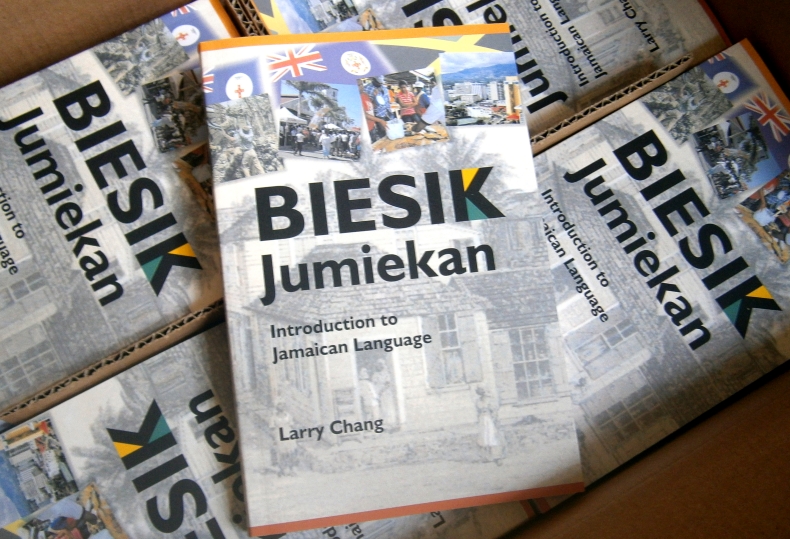
Our book Biesik Jumiekan, a greatly expanded print version of this site,
is published by Gnosophia Publishers under the Chuu Wod imprint.
Available from
Amazon.
Wa Jumiekandem taak
What Jamaicans speak
Di habrij Jumiekan di taak wa deh taak deh kaali patua, deh kaali kryuol, ar iibm bad hIngglish, askaadn tu ou deh fiil proud ar kaanful. Jumiekandem uona hatityuud divaid uoba di languij di wuola dem taak di muos, liklmuos aal di taim. Alduo hIngglish a di hofishal languij a di konchri, ah deh aal ab wa deh kaal Jumiekan hIngglish, a muosli bakra ah tapanaaris yu yie widi ina hofishal soerkl, anles smadi waah himpres wid piiki-puoki. Kaman
yuusij rienj frah Jumiekan hIngglish tu braad patwa wid bout chrii digrii a separieshan, noftaim ina di wan piika siem wan kanvasieshan.
hArijin a Jumieka Taak
Lingguisdem aidentifai "pyuor" Jumiekan, fain muosli a konchri, wid riijanal difrans, laka wah mixcho a sebmtiint senchri hIngglish ah Wes Afrikan, muosli Shwi, kanschrokshan ah vokiabileri, wid soh Panish ah Puotigiis iin de tu fi a gud mixop. Di haxent ah kiedens koh frah Skatish ah hAirish. Kansda di ischri a Jumieka, dis shudn sopraizn sens di bolk a di papilieshan a disendant frah piipl kyaa kom frah Wes Afrika, fos bai di Panish, den deh laan hIngglish frah deh
British uona, uobasia, hadvenchara, ah mishineridem.
Korant stietos
Potenshal, faib milian piipl, di papilieshan a Jumieka hingkluudn di dayaspora, taak Jumiekan ina wan faam ar di hada. Laka heni hada libm languij, ichienj ah kantiniu chienj uoba taim. Mosa honggl fyuu huol-taima baka bush a konchri ar aisoliet ina Brixtan ar Bruklin frah waa gwaan kiah kot di braad patwa, ar wa wi wi kom fi nuo haz hAakiek ar Klasikal Jumiekan (Si hAatagrafi, Jumiekan3). Di majariti taakin wi faal sohwe ina di migl a di spekchrom. Deh haazwie a mekop nyuu wod laka aatikal ah tapanaaris, ar chuu di hiiz a hintanashinal chrabl ah hilekchanik komiunikieshan, baara dem frah elswe, laka bling-bling frah ip-ap. Di languij wi chienj bot inaa ded faa itek iin eni nyuu wod ah Jumiekanaiz dem. So langx az Jumiekandem piich patan no chienj, deh wi kantiniu tek di siem hIngglish ah toni ina deh uona languij. No kia umuch deh waah sopresi, a hit Jumieka piipl wi haazwie taak. Idon du aredi. A deh languij muo dah heniting hels we set dem apaat az wah piipl.
Jak Manduora, mi no chuuz non.
The speech of the average Jamaican is variously described as a patois or creole, or even as bad English, depending on the degree of pride or disdain of the describer. Jamaicans' attitudes themselves are very divided over the language they all speak most, if not all, of the time. Although English is the official language of the country, and a variant known as Jamaican English is acknowledged, it is mostly heard only in formal situations, unless one wants to impress with "speaky-spoky." Common usage ranges from Jamaican English to broad patois with about three degrees of separation, often within a single speaker's conversation.
Origins of Jamaican speech
Linguists have identified "pure" Jamaican, now spoken mostly in rural areas, with regional differences, as an amalgam of seventeenth century English and West African, mostly Twi, constructions and vocabulary, with some Spanish and Portuguese thrown in for good measure. The accents and cadences have been derived from Scottish and Irish. Considering the history of Jamaica, this should not be surprising as the bulk of the population are descendants of people brought from West Africa, first by the Spanish, then taught English by their British owners, overseers, adventurers, and missionaries.
Current status
Potentially, five million people, the population of Jamaica including the diaspora, speak Jamaican in one form or the other. Like any other living language, it changes and continues to change over time. It must be only a few old-timers in the bush of the countryside or isolated in Brixton or Brooklyn who can still speak broad patois, or what will come to be known as Archaic or Classical Jamaican (see hAatagrafi, Jumiekan3). The majority speech will fall somewhere in the middle of the spectrum. New words are always being created, like haatikal and tapanaaris, or through the ease of international travel and electronic communication, borrowed from elsewhere, like
bling-bling from hip-hop. The language will change but it will never die for it absorbs new words and Jamaicanizes them. As long as Jamaicans' speech patterns do not change, they will continue to take English and turn it into their own language. No matter how much it is suppressed, this is what Jamaicans will always speak. It is so already. It is their language more than anything else that sets them apart as a people.
Jack Mandora, I choose none.
NYUUZ
Chek hAARKAIV fi huola haitem
NEWS
See ARCHIVES for older posts
OPDIET: Jumiekan Wikipidia
Afta faib ier a wok bai wah anful a edita, deh nou ab uoba 1,000 enchri. Wikipidia a-go chuu di apruuval pruoses bifuo ilaanch, uopfuli suun. Ef yu waah si wa iluk laik go yaso. Beta stil, ef yu nuo Patua ah kiah raiti in Kiasidi/JLU stailii, ton edita ah rait soh aatikl ar karek eniting yu si waah karek.
After five years of work by a handful of editors, there are now over 1,000 entries. Wikipedia is going through the approval process prior to launching which, hopefully, will be soon. If you would like to see what it looks like go here. Better still, if you know Patua and can write it in Cassidy/JLU style, become an editor and write some entries or make corrections to those existing.
Caribbean delegates press for language rights
Delegates from at least 12 Caribbean countries, including two governors general, met in Jamaica for two days recently, to press for the recognition of the rights of persons who speak Creole languages as a part of overall
human rights.
The delegates, including a number of linguists, said speakers of the region's Creole languages have a right to be communicated with in their first language, and not be discriminated against in accessing important services, including education, health and the justice system.
Participants also learned that in St Lucia, the governor general delivers parts of her Throne Speech to Parliament in Antillean Creole, while many words in Jamaican or Belizean patois are not a corruption of English as is widely thought.
The Conference on Language Policy in the Caribbean, hosted by the Jamaican Language Unit of the University of the Indies (UWI), was held at the Mona campus on January 13 and 14.
Full text Jamaica Observer, 2011/1/30
Niem gaan abraad
Fraitn fi si ou deh rait wi op aal ina Joerman. Wat a ting! Jamaikanisch – die gesprochene Sprache
Eine Mischung aus Englisch des 17. Jahrhunderts und dem westafrikanischen Twi
Ef yu kiah riid Joerman siit yaso.
Oldest Jamaican Creole Text
A 1781 text from the Cornwall Chronicle was discovered somewhere around 1997 by Maureen Warner Lewis in the course of her research. It is a big discovery for linguists studying Caribbean Creole languages. It is the oldest known text of Jamaican. In addition, it is the oldest text of a Caribbean English Creole outside of Suriname. It predates the next oldest known text, that for St Kitts, by at least 15 years. Full text
What about freedom from language discrimination?
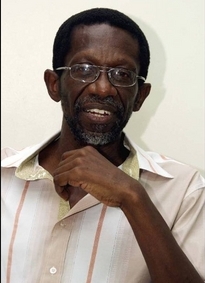
Hubert Devonish is professor of linguistics and coordinator of The Jamaican Language Unit at the University of the West Indies. He makes the case for the inclusion of protection from language discrimination in the Charter of Rights before the Jamaican Parliament. Send comments to
hubert.devonish@uwimona.edu.jm. Photo Gleaner
The Charter of Fundamental Rights and Freedoms is about to become law without any specific provision for freedom from discrimination on the grounds of language. This is against the background of a society in which two languages are used - English and Jamaican Creole. The former is the official language, but one in which all, except the educated minority, have limited competence. The latter is the native language of the vast majority
of the population and is used with facility by all sectors of the population.
English is the only language the institutions of government and state are required to use in the provision of services to the Jamaican public. We have a clear case of discrimination on the grounds of language, so why was freedom from language discrimination not included in the charter?
Full text: Part I
Part II
What language(s) should be used for instruction of Creole-speaking children in the Caribbean? This has been a subject of debate among educators and ministries of education in the region since the 1970s. This has been triggered by the continuing problems with literacy in English among school children within the Commonwealth Caribbean.
The Jamaican Language Unit (JLU) within the Department of Language, Linguistics & Philosophy at the University of the West Indies, Mona, spearheaded by Dr Karen Carpenter, developed the Bilingual Education Project (BEP) as a contribution to this debate. BEP sought to provide empirical evidence to policymakers in Jamaica as to the best way to proceed on language education policy. It sought to test, in a real primary-school situation, the potential positive effects of using a Creole language, in this case Jamaican, alongside English as formal languages of instruction and literacy.
The BEP was designed as a way of testing the position taken in the official Language Education Policy of the Jamaican Ministry of Education and Culture. According to that policy, even though the use of both languages as subjects and in literacy and oral instruction was ideal, it was not actually possible in the Jamaican context. The project sought to test this by designing and implementing precisely such a project. The goal was to show how that which
was said to be ideal could be turned into reality.
The Ministry of Education and Culture, after careful consideration, gave its approval for the project to proceed. The BEP was implemented in 2004 in three publicly funded primary schools. It tracked over a four-year period, a group of students who were taught in full bilingual programme, i.e. taught literacy and language arts in both languages, and content subjects in both languages. The BEP came to a close in July 2008, with the BEP children who had entered the programme in 2004 at Grade One, completing Grade Four. Participation in the project was voluntary. This was true of the schools, participating teachers who received special training, as well as the parents of the pupils involved.
Promises
Among the promises made by the BEP were that:
the BEP would produce an increase in Language Arts skill levels in English among pupils within the project relative to those in traditional modes of instruction;
the BEP would produce an increase in absolute literacy levels of pupils in the project, as shown by their literacy in their native language, Jamaican, as compared with non-project pupils for whom English was the only language of literacy;
the BEP children would show higher levels of competence in content subjects such as Mathematics, Science and Social Studies, since they were receiving instruction for this, not only in English, but also in their native language, Jamaican.
At the end of the third year of the project in 2007, a comparison was made of the Grade Three diagnostic Literacy Test results of the project children and those taught by the traditional method in the same school. At that stage, the project children had already developed a level of literacy in English which was slightly higher than that of those who had not been in the programme.
Based on the experiences of other such projects internationally, the projection was that this improvement should have taken place by the fourth year. In 2008, the same cohort of children took the National Grade Four Literacy Test. A preliminary analysis suggests that again, the performance of the project children in English literacy skills is better than those who were taught in the traditional manner.
Expert international reviewers listed and conducted the biennial review required as part of the project design. The overall results of the research are clear. An approach to the language-education issue in Jamaica which is innovative can indeed bring improved results in English Language literacy. The old approach sought to get rid of, or at least ignore, the children's native language, Jamaican. An approach which treated both languages equally
has proved to produce better results. The fully bilingual approach, as is shown the world over, produces improved language communication and literacy skills across the board, not only in the native language but also in the second language - in this case, English.
The BEP and the research surrounding it, have made another contribution. It has designed a model for the implementation of bilingual education in Jamaica. Elements of this model include
teaching standing writing system for Jamaican; and
the training of teachers, via a training manual and process, to present good models of English to their pupils by keeping the two languages apart.
The BEP research is not only relevant to Jamaica but countries such as Belize and Guyana. It is being viewed with interest by linguists and language educators across the Caribbean. - Jamaica Gleaner, 2010/06/27
Playwright Trevor Rhone dies
Photo Jamaica Observer
KINGSTON, Jamaica - Trevor Rhone, a Jamaican playwright who co-wrote the reggae film classic The Harder They Come and helped introduce the island's pop culture to the world, died Tuesday. He was 69.
Rhone died after a heart attack at a hospital in Jamaica's capital, Kingston, according to his brother, Neville, and playwright Barbara Gloudon, a longtime friend and colleague.
Born in 1940, Rhone wrote more than a dozen plays, including his two-character comedy, Two Can Play about a Jamaican couple who leave poverty-torn Kingston for an unexpectedly complicated new life in the United States.
But Rhone is best known for co-writing The Harder They Come, Jamaica's first feature film, in the early 1970s with Perry Henzell, a filmmaker who died in 2006.
Starring reggae singer Jimmy Cliff, the film became an international success, and its pulsing soundtrack, which featured reggae performers including Toots and the Maytals and Desmond Dekker, became a worldwide top-seller. More ...
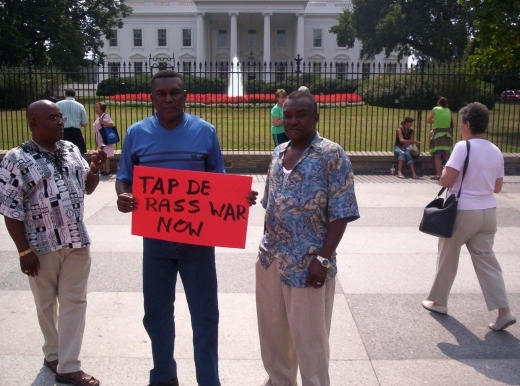
Pruotes fronta di Wait Ous. Nuot inkansistant pelin; shuda bi
Tap di raas waar nou
Ode to 'Miss Lou'
Louise 'Miss Lou' Bennett-Coverley championed the use of Jamaican dialect through diverse mediums.
Louise Simone Bennett-Coverley would have turned 90 today. Miss Lou, as she was affectionately known, was many things to Jamaica: a folklorist, the first lady of comedy and our linguistic mother. Through her expressive poetry, engaging storytelling and natural good humour, Miss Lou conveyed the passion and vivacity of Jamaicans and their language. In the process, she engrained a sense of identity in a fledgling nation. Three years after her death in Canada, Miss Lou still profoundly epitomises the indigenous Jamaican genius, as has been seen in other areas such as music and sports. Full story
- Jamaica Gleaner, 2009/09/07
Mi a born Jamaican and mi proud
An yuh fi feel proud too
Fi walk roun an big up yuh chest
An say tanks to Miss Lou.
When she did start, she neva know
A how it would a go
An nuff nuff people wen da laugh
An a call her pappy show.
But she galang strang and stick it out
For she know say she did right
Inna her belly battam she did know one day
Dem would a see di light.
Entime trouble teck wi a Miss Lou wen put
Wi good name pon di map
And wen da push Jamaica heritage
An Laad, she wouldn stop.
She say, "Tek kin teet kibba heart bun"
Wen times neva so sweet
"Good luck will come as long as fowl
A scratch up dungle heap".
Nuff a dem went ink she crazy
An nuff meck up dem face
How Miss Lou a chat dis boogooyagga Patwa
All ova di place.
For dem wen tink patwa was bad English
Dem neva know, poor ting
Dem wouldn tell dem pickney Nancy story
An folk song dem wouldn sing.
But a di jackass wid him long tail
Bag a coco comin dung
An did peel head jankro pon tree top
Jus meck dem head spin rung.
An lickle bi lickle dem start fi back her
Start fi fan her flame
An see deh, after fifty year
Miss Lou - a house hold name.
Now wi nuh shame fi chat wi owna language
An wi dah tank yuh fi it Miss Lou
Dem a teach it clear a university
An ongle sake a you.
Dem a mek flim, dem a write book
Dem a sing whole heap a song
An a say "Oh Patwa is a good language"
But yuh wen know dat all along.
So now wi tan up proud fi be Jamaican
An wi want di whole worl fi hear
Miss Lou, nuff tanks, for Howdy and Tenky
Neva bruck no square.
Wikipidia Jumiekan languij sait
Sens Disemba 2008, Wikipidia a tesout wah websait fi Jumieka languij. Efi wokout deh wi meki poermanent. Wail piipl a yaad a-gi out gens tiich patwa, di languij gaan abraad aal a mek insaiklopidia. Maitbi afta deh si se iaksep a farin, deh wi tekiop sens deh no siim fi hana eniting deh ab tel smadi els rekanaizi.
Go yaso
fi siit.
Buot Lari Chang ah Javed Jaghai kanek tu LanguiJumieka a mieja kanchibita.
Since December 2008, Wikipedia has been testing a Jamaican language website. If it is successful, it will be made permanent. While people at home are against teaching patois, the language has been accepted abroad for an encyclopedia. Now that it is gaining international acceptance, maybe they will take to it since they seem unable to honor anything without prior
external recognition.
Go here to see it.
Both Larry Chang and Javed Jaghai of LanguiJumieka are major contributors.
AKSHAN TAAK, is a Jamaican Language company (JLC) production done in association with the Jamaican Language Unit. It is a news commentary program done solely in Jamaican (More commonly referred to as Patwa or Jamaican Creole), which reports on how the media covers the news relevant to Jamaica and Jamaicans in general.
This inaugural episode looks at the recently held 2008 Olympic games and the different angles from which various media centers covered the phenomenal performance of the Jamaican athletic team.
Jumiekan iina Webster's Online dictionary
No nuo frah wen bot Jumiekan meki iina
Webster's Online Dictionary . Dem ab a gudli lis a wod ah hexpreshan wid definishan; yu nuo se a no nuo baan Jumiekan a kompaili far bikaazn se som a dem no kwait kech di riek, bot iyuusful az refrans. Beg yu nuot se muos a di pelin fala miizolek aatagrafi, wa wi wuda kaal fala-fashin Ingglish pelin wa no riili gi di dairek soun, so kieful ou yu fala dem.
We are unsure when, but Jamaican has made it into Webster's Online Dictionary. There is an extensive list of words and expressions with definitions; you can tell it was not compiled by a native Jamaican since some of them are a little off, but it is useful as reference. Please note that most of the spelling follows mesolectal orthography, or English-based approximations, which do not represent the true sounds, so be careful in
adopting them.





 Hubert Devonish is professor of linguistics and coordinator of The Jamaican Language Unit at the University of the West Indies. He makes the case for the inclusion of protection from language discrimination in the Charter of Rights before the Jamaican Parliament. Send comments to
hubert.devonish@uwimona.edu.jm.
Hubert Devonish is professor of linguistics and coordinator of The Jamaican Language Unit at the University of the West Indies. He makes the case for the inclusion of protection from language discrimination in the Charter of Rights before the Jamaican Parliament. Send comments to
hubert.devonish@uwimona.edu.jm.