|
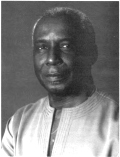
Prof. Rex Neklfoerd
Prof. Rex Nettleford
Nuf rispek on the site you put up! I am German and doing research on Patois on the internet and have recently completed a PhD on it. I will teach a course on Jamaican this fall and hope to be able to use your site as teaching material then.
- Lars Hinrichs
University of Freiburg
2005/7/11
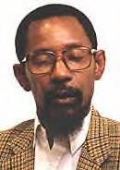
Lintan Kwesi Jansn
Linton Kwesi Johnson
I've just been sent news of your Jumieka Languij website by a fellow linguist. Unlike most such work by non-professional linguists, I found it to be comprehensive, accurate and systematic, and informed by a positive perspective on the Jamaican experience, not just a juokifai one! Thanks for your work - it makes a great approach to a deep subject, not only for outsiders but also for those of Jamaican origins who want to find out more about their (parents') precious native language.
- Peter L. Patrick
Department of Language & Linguistics
University of Essex
2005/7/12

Prof. Yuubert Devanish
Prof. Hubert Devonish
I am so impressed by your website - it is wonderful - so informative and uses Cassidy ... Also can we please use - with full credit some quotes off your website. If we can sort the technology I would actually like to demonstrate the website - I show all my contacts and this evening watched as two older Jamaican friends laughed and read, lost entirely to the website!
It is the greatest teaching tool that could have possibly been prepared.
- Liz Millman
Jamaica 2K
2006/1/20
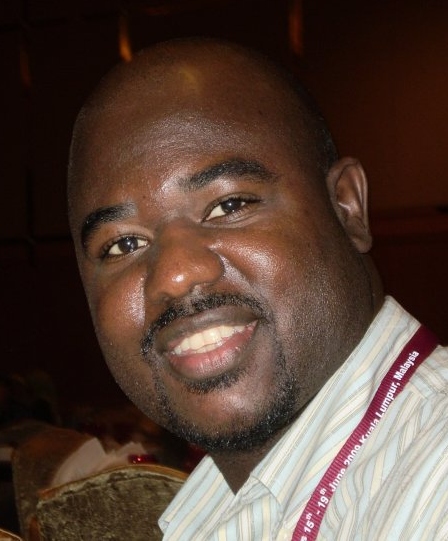
R Antoni Luwis
R Anthony Lewis

Lui Mariat
Louis Marriott

Prof. Jan Welz
Prof. John Wells

Stefani Tiem-Durlman
Stephanie Tame-Durrleman

Jef Broun
Geof Brown

Piita hEspyuut
Peter Espeut
Prof. Kiarolin Kupa
Prof. Carolyn Cooper

Laid B. Simit
Lloyd B. Smith

Karis Chin-Kwii
Karis Chin-Quee

Yasus Afari
|
WA DEM A SE
What they're saying
|
KWUOT A DI DIE
Yu nuo wa? Lieta aan ina laif wen mi son se ih waah bi prezident a di Yunaitid Stiet, at liis dis taim wen mi luk pan im - bifuo mi uda se 'ye, man' - bot at liis dis taim wen mi si so mi kiah miini frah di batam a mi aat se ih kiah dwiit.
- Maxine, in Daily Gleaner, 2008/1/20
|
The mother tongue is indispensable in all forms of progress of a community: psychological and intellectual balance of its members. If we continue to force the child, Martiniquais, to subject to a lifestyle in French at school and a Creole one at home, we will reinforce the process of collective irresponsibility plaguing the Martinique community ... a people who is reduced to practice its language only at home is condemned to face the death of its culture, of which this will only be the mirror reflection of an otherwise real agony.
- Edouard Glissant, writing about Creole in Martinique
We keep knowledge from the majority of people by denying them knowledge in the language they use. There is something very wrong in saying to a human being, 'Let me cut off your legs and I will give you artificial ones, which will be perfect.' I'm saying let us walk on our own two feet. There is a younger generation now who are willing to contemplate literature or the possibility of literature in African languages. This is not just African, it applies across the Global South - there is an enormous heritage that has been lying untouched. It really excites me, even though it is not now the dominant thread. We must make the marginalised languages accessible. Then the elevation of translation should be part and parcel of a modern education, along with the acquisition of more than one language... There are several writers who now write in Gikuyu. Ms. Waithira Mbuthia is very prolific. But so is Gitahi Gititi, now a professor of English, but writing in Gikuyu. Mwangi Mutahi is another who has published three novels in Gikuyu. There is also Gatua wa Mbugua, a poet and a scientist. He has just completed and successfully defended a scientific thesis written entirely in Gikuyu for the Department of Crop Science at Cornell. There are many more. Most of these writers are contributors to the Gikuyu language journal, Mutiiri, originally based at New York University, but now at the University of California Irvine.
- Ngugi wa Thiong'o, Kenyan writer who initiated literature in his native Gikuyu tongue
... the most directly African element in Jamaican culture is verbal - most of all storytelling, but also just in simple turns of phrase and in the social attitudes that go with those turns of phrase.
- Edward Lucie-Smith
in an interview with Dr Jonathan Greenland
Jamaica Gleaner, 2008/07/13
Read Quote of Alex Lew's answer to How much time does it take an average adult to learn a new language? on Quora
Why Freedom from Language Discrimination in the Charter of Fundamental Rights and Freedoms?
The on-going debate on the issue of whether people who do not speak English experience discrimination in Jamaica, and if so, what should the law and constitution do about it.
— Prof. Hubert Devonish
Jamaica Language Unit
|
|
KAMENCHRI
|
Cultural revolution
- Stuart Hall
ina 'Negotiating Caribbean Identities,' New Left Review, I.209, 1995 |
|
When I went back to Jamaica at the end of the sixties and in the early seventies, it was a society even poorer than when I had left it, in material terms, but it had passed through the most profound cultural revolution. It had grounded itself where it existed. It was not any longer trying to be something else, trying to match up to some other image, trying to become something which it could not. It had all the problems in the world sticking together, finding the wherewithal to get to the next week, but in terms of trying to understand ordinary people — I'm not now talking about intellectuals, I'm talking about ordinary people — the important thing was the new realization that they could speak the language that they ordinarily spoke to one another anywhere. You know, the biggest shock for me was listening to Jamaican radio. I couldn't believe my ears that anybody would be quite so bold as to speak patois, to read the news in that accent. My entire education, my mother's whole career, had been specifically designed to prevent anybody at all, and me in particular, from reading anything of importance in that language. Of course, you could say all kinds of other things, in the small interchange of everyday life, but important things had to be said, goodness knows, in another tongue. To encounter people who can speak with one another in exactly that transformation of standard English which is patois, which is creole — the hundreds of different creole and semi-creole languages which cover the face of the Caribbean in one place or another — that these have become as it were the languages in which important things can be said, in which important aspirations and hopes can be formulated, in which an important grasp of the histories that have made these places can be written down, in which artists are willing for the first time, the first generation, to practise and so on, that is what I call a cultural revolution.
Stuart Hall is a Jamaican-born cultural theorist and sociologist who has lived and worked in the United Kingdom since 1951. |
Respect for our own
- Rex Nettleford
ina 'Cultural Action in Independence,' Jamaica in Independence: Essays on the Early Years (Kingston: Heinemann Caribbean, 1989) |
|
The richness of language (outside of its use for literature), for example, is particularly relevant in Jamaica's case. And though the anguish has grown deeper over the 'O' Level failures in English Language and the debate has become more vocal as to the place of dialect in our cultural universe, it is clear that good sense will eventually have to prevail. The use of Standard English for official and formal discourse is not incompatible, after all, with the common usage of a tongue created by the Jamaican people over three hundred years for their own use and to describe their own reality.
All of this naturally goes beyond the public recognition given Louise Bennett, the leading poet in the language, who after fifty years at her craft has become a living source for scholarly and artistic work involving the Jamaican language. It is safe to say that its acknowledged pedigree as a genuine twentieth century creole tongue (thanks to the work of Frederick Cassidy, R. B. LePage and others) has been helped as well by the growing respect for things Jamaican among Jamaicans themselves since Independence. It is a point deliberately missed by a school of thought that would seek to deny to Jamaicans the capacity to exercise their creative imagination and intellect in ways that produce things of value distinctive and different from what was regarded as 'high culture' coming from the imperial metropole. Happily, the spirit of self-determination prevails, albeit precariously, and the foreseeable future should be challenged to maintain the integrity of that spirit, if Jamaicans are to acquire the self-confidence which is mandatory for genuine change and development.
Rex Nettleford is a leading Caribbean scholar, former Vice Chancellor of the University of the West Indies, founder and artistic director of the National Dance Theatre Company |
Nation Language
- Linton Kwesi Johnson
iina hintaviu |
|
People say that Jamaicans speak 'Patois' ... The term 'Patois' is unhelpful to describe the languages of the Caribbean. I prefer to use the term which the Barbadian poet Brathwaite uses which is the term 'nation language' ... Patois is a term which really refers to broken French. It is sometimes used to describe what is spoken on the English Caribbean islands, but I think it's an unhelpful term, because it is really basically referring to the French islands... But to give you a simple answer to your question, the language I'm writing is mostly Jamaican.
Linton Kwesi Johnson is a Jamaican dub poet in the UK
|
Language as identity
- Linton Kwesi Johnson
in Jamaica Gleaner, 2006/10/15 |
|
Language is about identity, and when I began to write in verse, I knew I wanted to use the kind of language that could best convey the experiences I wanted to articulate, and I knew that was not going to be the rarefied language of classical English. For me, one of the defining characteristics of poetry is authenticity of voice, and my natural voice is the ordinary spoken Jamaican language. |
Language rights, justice and the constitution
- Hubert Devonish in Jamaica Gleaner, 2002/01/27
Full text |
|
Public servants who deal with the public will have to be trained to render courteous and efficient service orally in both the languages in which they are required to operate. Written material in Jamaican would not, in the first instance, be a priority for communicating with the public. This is so since, in Jamaica, nearly everyone who is literate exercises their literacy in English.
However, officials who interact with the public will themselves need to be literate in Jamaican. They would use this literacy to consult technical wordlists and Jamaican language versions of documents, the contents of which they need to communicate to the public.
Public bodies will have to be especially creative. This is because, given the general absence of literacy in that language, almost the entire provision of services in Jamaican will have to be done orally. Jamaican language versions of public documents could be prepared, not for direct use by the public but for public officials to read to members of the public with limited understanding of English. Forms to be filled out could be made available through sound recordings accessible via telephone lines.
The questions on the form could be asked orally by way of a sound recording. Answers to the questions, e.g. name, address, date of birth, etc. given orally on the telephone could be entered into the records of the public body either through speech recognition technology or by subsequently playing back the recorded answers.
This practice has been in place for over a decade, employed by public utilities in places such as California, not just for speakers of minority languages such as Spanish, Korean, Vietnamese and Chinese, but for speakers of English as well.
Hubert Devonish is Professor of Linguistics at the University of the West Indies |
Teaching in patois
- Dr R Anthony Lewis
iina leta tu di hedita, The Jamaica Observer, 2005/12/3 |
|
For years many in this country have argued for English to remain the sole language of instruction. It seems that proponents of this argument have not realised that this approach has left us with lower proficiency in English, not to speak of the decreasing competence in other subjects taught in that language.
The extent to which teaching in English to predominanty Jamaican-speaking students affects performance on examinations set in English remains to be studied. But it would be surprising if it did not have a negative impact. If instruction in English worked as well as the English-only proponents argue, we would have seen, after all these years of using English as the sole language of instruction, more Jamaicans gaining access to the world through that language. Unfortunately, the records show otherwise.
As a teacher of language (English and French and at one time, Spanish), I have argued in the press and other fora for an approach to language education that appreciates languages as tools that aid in acquiring information and particular cognitive skills. Each language studied provides increased access to information and knowledge but also to the acquisition of a subsequent language. The refusal to recognise Jamaican as a tool through which our children may gain information about the world is tragic, not only because it devalues their primary means of accessing information, but also because it fails to appreciate the role of that language in the successful acquisition of their second, English.
Preoccupations about learning English alone do not make English speakers. The absurdity that the promotion of Jamaican will prevent Jamaican students from learning English is intellectual blackmail. It suggests that Jamaican students, unlike their counterparts in the rest of the world, innately lack the capacity to learn a second language because of the fact that they already speak another. This view has led to an arrogant language education practice that insists on our students accessing knowledge through a language that is not their own.
Linguistics tells us that any normal child, under the appropriate conditions, will learn any language. Let us look towards providing the appropriate conditions for our children to learn English rather than the persistent denigration of Jamaican. While exposure to English is one of the conditions for achieving proficiency in English, there is a difference between linguistic immersion and linguistic submersion.
Without the recognition of Jamaican and its structured use in at least the primary system, we produce students who struggle against the tide of English. When they get to the tertiary system, people like me have the joy (!) of attempting remediation. Alas, by then, it is too late. Ironically, the Anglophiles succeed in reinforcing the position they so stridently argue against.
But perhaps that is what they want. In this extremely classist society, scoffing at people who drop "h" or who hypercorrect remains one of the most potent tools among those for whom class distinctions, marked by language, are critical.
|
The Jamaican Language Issue
- Louis Marriott
in The Gleaner , 2006/9/17 |
|
My late father's formal education ended at primary level. However, as other members of his immediate family, he aimed always to speak standard English. Although otherwise an ardent nationalist — he was the 109th member of the People's National Party — he insisted that his children should communicate in English.
Once, one of my younger sisters ventured, "Im tell mi seh."
"Child," snapped our father, "what was that?"
A startled child quickly corrected herself: "He told me say."
My little sister's confused reaction showed that she shared with a large percentage of our population a misguided notion that our national language is "bad English", "broken English", a dialect of English, or patois.
I am no linguist, but I have had the good fortune to have studied Spanish and Latin in high school, to have travelled widely, and to have been a creative writer, mainly of drama, over the past 50 years. This exposure has given me insights into the issue of language usage in Jamaica which I believe to be relevant to the debate that has raged for a number of years and, which has been revved up by the recent passing of the foremost matriarch of the Jamaican language, the Hon. Louise Bennett-Coverley.
Fishermen's speech
In the late 1950s, I wrote a playlet for the Government Broadcasting Service designed to encourage fishermen to equip their boats with outboard motors. It was a "two-hander", mainly a conversation regarding the merits of the outboard motor. It was sent to the Government Fisheries Officer to authenticate or correct the technical information in the work.
The text was returned with no change whatsoever in the information, but beautifully retyped with my vernacular conversation between two Jamaican fishermen now translated into impeccable standard English dialogue.
On my first visit to Curacao, in 1967, I noticed that the hotel chambermaids spoke better English than the average secondary-educated middleclass Jamaican. On inquiry, I learnt that they compulsorily learnt four languages in primary school — their native Papamiento, the imperial/colonial Dutch, and the two dominant languages of the region, Spanish and English. Also, there were two daily newspapers in papamiento serving a population of slightly more than a hundred thousand.
'University of Brixton'
In 1970, I was commissioned by the English by Radio Department of the British Broadcasting Corporation (BBC) to write a drama series to facilitate communication between Jamaicans living in Britain and members of the host population. I set the series in the Jamaican community of Brixton and titled it "The University of Brixton". Each episode began: "Welcome to the University of Brixton. You won't get degrees or diplomas here, but you can get a first-class education."
Among the cast were some notable Jamaican actors - Charles Hyatt, Mona (Chin) Hammond, Frank Cousins, Karl Binger and myself. The narrator was Gerry German, a Welshman who spent some years in Jamaica as principal of Manchester High School.
The BBC engaged Dr. John Wells, now Professor of Phonetics but then Lecturer in linguistics at the University of London, to be my linguistic advisor. A young Englishman, Wells had done his PhD thesis at Cambridge University on an aspect of the Jamaican language. For his field work, he had spent eighteen months living at Bundy Lane, a deprived community off Old Hope Road near Swallowfield, and from time to time took a portable tape recorder and a notebook to various parts of the country to record the nuances of Jamaican speech.
There was no doubt in his trained mind that Jamaican was a legitimate language — not a dialect or patois. His rationale was that although many Jamaican words were derived from English and some West African languages — following a common formula in the evolution of languages — there was now a distinct Jamaican lexis and a Jamaican grammar that was a great deal more regular than English grammar.
He introduced me to Beryl Loftman Bailey's classic Jamaican Creole Syntax, which immediately became my Bible of the Jamaican language.
Respect for Jamaican
An intriguing feature of the University of Brixton was that both John Wells and the BBC, the final arbiter of the English language, wanted full recognition and respect to be accorded to the Jamaican language. Its integrity should not be questioned. The issue was simply one of effective and harmonious communication between members of the Jamaican community living in Britain and the host population.
This I found to be in sharp contrast to the situation in Jamaica, where many of our decision-makers and opinion-leaders have a disrespectful and/or condescending attitude to our language.
In my exchanges with John Wells, I became more and more aware of the extent to which many of our better-educated middleclass citizens who imagine themselves to be highly proficient in English really speak and write bad English. This provided me with copious material for dramatic situations, mostly of the comic variety. A typical example was the Jamaican who broke a glass when cautioned by his English companion to be careful not to break it. He deliberately broke it because his interpretation of a commonly used English idiom was precisely the opposite of its standard English meaning.
Bizarre debate
Following my return to Jamaica in the early 1970s, I became aware of the intense debate that was taking place regarding language education. I have found it a bizarre debate because the anti-Jamaican case consists of vehemently countering a proposition that no one has advanced.
My understanding is that some educators would like to teach the Jamaican language to Jamaican schoolchildren, not to displace English but in addition to English. They believe that studying the structure of their own language will make it easier for them to cope with English or any other language. A number of persons think this unnecessary because, they argue, our children already know Jamaican, so they do not need to study it in school.
Why then, I ask, do English children study English?
Another argument is that Jamaican should not be taught because of the small number of people worldwide who speak it.
So why did they teach me Latin in school? And what about the large number of people outside our shores, especially young people, who are very interested in Jamaican culture, including our language? And why are English universities now offering courses in the Jamaican language?
Louis Marriott is a Jamaican dramatist and writer. |
Exploring the unique Jamaican creole
- Stephanie Tame-Durrleman
in
Jamaica Gleaner, 2007/12/16 |
|
One thing that became evident to me in time was that we often unconsciously perpetuate inherited and useless prejudices if not forced to abandon them. My studies at the University of Geneva confirmed this in many areas, and one of them was language. I was exposed to refreshing ideas about linguistic systems and it soon became clear to me that Jamaican creole is not a 'corruption' of a language, but a 'language' in itself ...
... We need to recognise that Jamaican creole is a full-fledged language for various reasons. First of all, it is simply not accurate to define it as anything else. Scientific approaches to any natural human language have consistently upheld the complexity of each linguistic system, and Jamaican creole is no exception to this rule ...
... The respect of the child's mother tongue in the classroom may ultimately take us a step further. That is, it may even prove beneficial for certain students who are, for example, very strong in maths or art, but struggling with English, to ultimately have the opportunity of having the subject explained in their mother tongue, without having to face the obstacle of learning it in a foreign language ...
... Why, then, deprive our children of a potentially more efficient methods of teaching? I know this will shock many, who will argue that there are not enough of us speaking Jamaican creole in the world to justify such an approach. However, do the Icelandic people teach in English just because their language is only spoken in Iceland? ...
... Keeping English is important in our society, (but it) does not necessarily imply that we must trample on the image of our national language and complicate the learning task in the process. Indeed, a positive image of one's native language contributes to overall self-confidence, successful learning in general, and the ability to acquire a second language as well ... Needless to say, I hope my children will not only speak French and English, but also Jamaican patois.
Stephanie Tame-Durrleman, is a Jamaican national, and senior lecturer in the Department of Linguistics, University of Geneva, Switzerland. Her thesis, "The Syntax of Jamaican Creole: A Cartographic Perspective which Explores Jamaican Patois In Depth" received highest honours. |
A wah?
- Kadene Porter
in Abeng News Magazine, 2008/2/17 |
|
We Jamaicans are confused about matters relating to our patois. We are unsure of how to position it, whether to officially acknowledge it as part of our national identity or to keep it in its place in a box marked "broken English". Some of us blame its widespread use for the diminishing CXC passes in English, and in fiery protest call for a ban or containment of its use in schools. In asking a new CXC level student to correct the expression "A wah?", one teacher recruited from overseas was horrified to hear "Is what that?" prompting her realization that even the basic syntactic rules of Standard English were blurred in the minds of her students. But how to correct the perceptions that exist? How to advocate the necessity of learning Standard English without diminishing the importance of our Patois and mother tongue of the majority? Few of us seem to realize that what we now hold up as "Standard English" was in its infancy one of hundreds of the regional dialects spoken in England, and like our Patois, went through similar rites of passage before a single form emerged, or was chosen, as the standard.
Two waves of invasion wrought major change on the Old English dialects brought to the British Isles by Germanic settlers and invading Roman auxiliary troops; the 8th and 9th centuries saw colonization by language speakers of the Scandinavian branch of the family of Germanic languages, and in the 11th century with the invasion and occupation of the Normans, the Romance branch of European languages was infused into the existing Germanic (Anglo-Saxon) core. The term "Romance" here does not pertain to matters of the heart, but to the Vulgar Latin, the Roman language of settlers, soldiers and merchants, not to be confused with classical Latin used by Roman intellectuals. The earlier introduction of Christianity with its wave of classical Latin and Greek did not have much impact on the spoken language then, since these language forms were used exclusively in liturgical circles.
Since the language of the aristocratic Normans entered the existing spoken Germanic English dialects through governments and the royal court, it was understandable that it would enjoy an elevated social status, relegating the other varieties to inferiority, and as dialects of common and coarse folk. However, the Anglo-Saxon dialects absorbed many foreign words, increasing their vocabulary by leaps and bounds, and over a 300 year period, while cohabitation played havoc with the sharp distinctions between the Anglo-Saxon and Anglo-Norman, their basic class distinctions remained. The purer French-based dialects retained their prestige through the language of diplomacy, and to this day the French entries into English are still associated with more formality, compared to those Germanic with the same basic meaning. Nowhere is this more distinct than with the words describing bodily functions and their connotations. Since Saxon words were used mostly by the vulgaris, Latin for the common (unlearned) people, the snobbery of the French frowned on their use, and the very word "vulgar" adopted a pejorative connotation of 'coarseness'. These Germanic words have remained "vulgar" to this day through what we now call four-letter words, perpetrating and perpetuating the prejudices of French aristocracy. Thus "urinate", "defecate" and "copulate" are socially acceptable while their four-letter Saxon counterparts are still considered outcasts.
While the language of the royal court prevailed, and the expression "the Queen's English" goes back to the times when the language of the monarch was used as the standard in speech and writing, just look at English today. The language of the court itself eventually became influenced by the "inferior" dialects through literary and dramatic productions, and it is interesting to note that major literary works prior to English standardization, as in the case of Shakespeare, employed much of the vernacular of the day, thus helping to shape modern English usage. The language form that emerged has drawn its vocabulary from many of the dialects in use around it through each stage of development.
Our colorful Jamaican Patois is perhaps going through its own historical middle passage, where after years of pondering over its standardization, making it a national language, or one of two official languages, we still have not taken any definitive action, and the language is still accorded the lowly status of the Anglo-Saxon as it contended with the Anglo-French. For as long as we entertain the notion that this is not a valid language with its own set of rules, and is merely "broken English", we will continue to experience the same frustrations with the low number of passes in the Caribbean Examination Council (CXC) school
leaving tests, and the inability of the masses to enter the global sphere of
communication and commerce.
Our vernacular needs to be recognized as a mode of communication distinct from Jamaican Standard English, even with much of its vocabulary English-based. If there is this recognition, then the English standard will be taught as a second language and not as though it is the mother tongue. Back in the day Standard English was taught at school much like any other foreign language, students were given the opportunity to be immersed in it. Teachers spoke it impeccably to assist with its mastery, and collaboration by the the newspapers and radio programmes reinforced the lessons. Although some parents insisted on Standard English at home, from the angle of "speaking properly", the vernacular itself was never forsaken; speakers employed 'code-switching', as there was an unwritten code about when and to whom it should be spoken, establishing from an early stage the fact that there were two distinct modes of communication within the student's grasp. In our day we mastered both forms.
Nowadays the average student has few means of being immersed in Standard English, as there is no concerted effort to maintain a clear distinction between both language forms. The local newspapers seem to be struggling to maintain the standard, and save for the news items and select programmes, the airwaves produce a steady diet of mesolectal fare, further blurring the lines between the two. How do we expect our young CXC candidates to be proficient in the use of the English language if it is not being taught and reinforced? At what point are the basic rules of English grammar being taught to them? Many of them neither hear it at home nor from their teachers, and as major works of English literature are gradually disappearing from their curricula, how do we expect them to compete on an international level with others having a broader frame of reference? As any student of foreign languages will tell you, "If you don't use it, you'll lose it", meaning that proficiency in any language can only be achieved through practice. Part of the audio-visual method of teaching a second language involves hours of practice, listening and reproducing the same sounds until they are perfected. So our students who have no opportunities to practise speaking Standard English are at a distinct disadvantage, and we will continue to fight a losing battle in preparing them to communicate with the world.
I acknowledge that we are trapped by the existing language continuum which places the Patois as the basilect at one extreme, with the Jamaican Standard English as the acrolect at the other, with the mesolect in between. It may be in truth the mesolectal levels which now masquerade as our Standard English, further leading us to believe there is no need to clearly distinguish between both extremes. I believe that the key to regaining the importance of learning Standard English is to give equal prominence to our Patois, not only through codification and standardization, but lifting it to the level of national language, thus removing the social stigma attached to its use. As clearer delineations are drawn in comparison to the Standard English, there will be an acknowledgement of the coexistence of two distinct languages, and the realisation that we can become truly bilingual. After we clear the hurdle of awarding the Patois national language status, the next level may be to make it one of two official languages.
The decision to give our Patois national language status will only prompt a more intensive and thorough approach to both teaching and learning English. Then it will be made easier for the student who asks: "A wah, a wah, a wah?" to be able to correctly translate this as "What is it?", realizing that both expressions are of equal merit. Perhaps the foreign teacher will realize it too.
|
Patois as language or broken English?
- Geof Brown
in Jamaica Observer, 2008/7/04 |
|
Suddenly it seems the old debate on the status of our primary mode of expression as a legitimate language versus what has been called the "accepted" English tongue, has again broken into the open. Kadene Porter in a recent article in the Observer and a letter in the Gleaner, has very ably put the arguments on the table. I hope readers will avail themselves of her reasoning. She herself has capability in three foreign languages and is not as limited a judge as most of us. Ms Porter suggests what our linguistic experts have been urging all along, that is, we are moving towards bilingual status. This prospect horrifies some of us to whom Standard English is sacrosanct. The common "patois" as an evolving language in its own right is seen by some as a threat to the preservation of "accepted" Standard English. Indeed, the prejudice is hardly disguised when standard English is referred to as "proper" English.
Thus "improper" English is what most Jamaicans in fact speak, since our creole and truly first language is fully intertwined in the daily oral interchange we have with one another. English is reserved for formal print and formal speeches. Very few Jamaican households insist on standard English as the primary mode of speech. We are coming close to the English of whom it was said, "Why can't the English learn to speak English?" In my own lifetime, many years of which were spent abroad, I have seen the ascendancy of our creole from the vernacular of the lesser educated groups to become the everyday language of choice of most of the more educated classes. This is living proof that language is an ever-changing product of a people's culture.
We have seen Latin fade and die as a "proper" language of well-educated European peoples. Who wants to take any bets that our creole language is about to fade and die? At one time my critique was that our primary oral Jamaican language lacked formal grammar and syntax and therefore did not meet the test of a language that could be acquired by a visitor new to it. I used the comparison of Swahili in East Africa. On my first visit to Kenya, I was able to buy a book of Swahili grammar and syntax. With that grounding, it was relatively easy to add vocabulary. Had I continued to reside in the country, within months I would have been able to converse with some fluency in the acquired language. A daughter of mine hated French in high school. After a year in Switzerland immersed in the language, she was described in her term report as having acquired "an excellent mastery of French". As we know, when one is comfortable in one language, this comfort aids the acquisition of other languages. Note that European children in school often acquire three or more languages.
In Jamaica, the majority of our people are not fluent in reading or writing Standard English. Some very bright university students still need remedial English in order to handle their work. Contrast the example Porter's article cited of a child who arrived in Jamaica with French only and who was able in one year to pass CXC exams with distinctions. I return to my former critique that our creole lacked formal written structure, and now formally withdraw that critique. For indeed, there has been a formal written grammar and structure of patois for over 30 years, backed by a body of substantial scholarship on the language. I refer to Jamaica Talk by Frederic Cassidy and Robert Le Page, available in the UWI bookshop, and no doubt elsewhere.
There is also a scholarly dictionary of the Jamaican creole, the Dictionary of Jamaican English of over 500 pages. An overseas visitor asked me recently why the UWI Linguistics Department isn't more active in promoting the distribution and use of the two works mentioned. Probing that concern, I have discovered the simple truth. The Linguistics Department at UWI is simply not funded sufficiently to undertake this necessary duty. It would be easier to get funding to study why tree frogs croak in a certain way. And the real truth behind that truth, is that we have a colonial hangover in which the language of the former master is the only one worth legitimising. Never mind that it is patois which is more correctly termed our mother tongue while English is our second language. The real issue is the necessity to recognise the importance of the emerging bilingual status of our country and to legitimise that status through the early teaching of English as a second language.
Indeed, the Ministry of Education has officially started on this inevitable road of bilingualism. The Bilingual Education Project was approved and implemented by the Ministry in two project schools in 2004. It involves full and equal use of Jamaican (creole) alongside Standard English in all aspects of the education process from Grades 1 to 4 (so far) at the primary school
level. They both function as languages in which literacy and other subjects are taught, and as media of instruction. Results of the Grade Four literacy tests are pending, but indications to date are that the "guinea pigs" are achieving better than the classes before them. This project strongly challenges the traditional negative attitudes towards Jamaican creole.
Perhaps someone should bring Prime Minister Bruce Golding up to speed in view of his recently expressed scepticism of any usefulness in promoting Jamaican creole. A survey of 50 of the 60 members of the Lower House of Parliament in 1999 indicated that 60 per cent of them would support legislation giving official status to Jamaican alongside English. (Quoted from Society for Caribbean Linguistics, "Full Bilingual Education in a Creole Language Situation", Occasional Paper Number 35). The Ministry of Education has an official policy promoting the use of creole as a language of instruction in the early years, even if funds are yet unavailable to effect texts to support this respect for first language. Let us face facts and act accordingly. |
Teaching in Jamaican creole?
- Peter Maxwell
in Jamaica Gleaner, 2008/7/13 |
|
I have real sympathy with those who are surprised that anybody in a school would want to make use of the Jamaican language (which the academics call Creole and the rest of us call Patois). After all, most of us have been socialised into believing that it isn't a language at all, that it is at best a dialect of English — suitable for entertainment, perhaps, and for chatting with your family and friends — but that it should have nothing to do with education.
What is true, though, is that a number of wise people have been trying to show us another side of the story for two or three generations already. People like Beryl Loftman-Bailey, D. R. B. Grant and Dennis Craig taught a lot of others that the Jamaican language is not just a dialect, since it has its own system of rules, both for grammar and for pronunciation, and that while most of its words are derived from English words, it is as different from English as Portuguese is from Spanish, or as Haitian is from French.
Target language
Others, like Mervyn Alleyne, Hubert Devonish and Pauline Christie have, for decades, explained that it is known all over the world that if your home language (Jamaican, for instance) is recognised and respected, you will learn a target language (English, for instance) more easily. This is why organisations such as the National Association of Teachers of English (NATE) have encouraged teachers to help children to learn English by noting the similarities and differences between the languages.
Clearly, it is to our advantage to have all Jamaicans proficient in the use of English. Unfortunately, too many adults who claim to be speakers and writers of English set a very poor example for others, never having understood those differences, and getting confused about singular and plural form, about the agreement of subject and verb, or of pronoun and antecedent, and about the accepted form of idiomatic expressions.
At the beginning of this 21st century, the Ministry of Education set up a
committee to develop a language-education policy for Jamaica. A careful document was drawn up, with the assistance of able and concerned educators and other stakeholders, and circulated for comment in 2001, prior, we were told, to being submitted for executive approval at Cabinet level.
Official language
According to this document, the proposed policy retains Standard Jamaican English (SJE) as the official language and advocates the policy option of transitional bilingualism, promoting oral use of the home language in schools until skills in SJE are developed. Within this option, emphasis is placed on the employment of bilingual and bidialectal teaching strategies, particularly at the early primary level and again at the early secondary level, where numerous language and literacy needs are also manifested.
It is a pity that the scholarship and good intentions of that transformational exercise appear to have come to nought. Nothing further was heard of it.
Peter Maxwell is an educator and editor of the publications of Jamaica's National Association of Teachers of English.
|
|
The Bible in Jamaican
- Peter Espeut
in Jamaica Gleaner, 2008/07/15 |
|
The Bible Society of the West Indies has announced that it has commenced a project to translate the Christian bible into the Jamaican language. The project has good intentions, for it is a fact that the best way to get a message across to a people is to communicate with them in their own language. And yes, Jamaican Creole is a separate language - related to English, but different. We have the Hon Louise Bennett-Coverley to thank for her role in making our language 'respectable', and for making us comfortable with ourselves. I wish the effort well.
Ambitious project
It is, of course, a tremendously ambitious project, for there is no such thing at the moment as Standard Jamaican Creole. Different dialects are spoken in different parts of Jamaica. One immediately thinks of those in the west who say: "Him ben a come" while others (from the east) say: "Him a come". Both are 'correct', but they are different, and since I do not expect the translators to produce more than one translation, they are going to have to make choices about which variations they will use. And there are many variations. People from deep rural St Thomas speak slightly differently from people in deep rural Portland, and again differently from those in upper Clarendon. There is uptown Jamaican Creole and downtown Jamaican Creole, not to mention the Rastafarian variation. Into whose Jamaican Creole will the Bible be translated?
There is a danger that, with the hegemony of the big city, the translators will produce an uptown St Andrew Creole Bible, the Mona Version, which may defeat their purpose. I remember the disdain with which many in the ghetto treated the Uptown Reggae of Pluto Shervington and Ernie Smith in the 1970s. If the idea is to reach the Jamaican people with a creole Bible, which Jamaican people will be targeted?
First translation
When the Bible was first translated into English in 1611, the well-known King James Version (KJV), there was no such thing yet as Standard English. English was a relatively new language, widely spoken, but with a limited literature and much variation in expression and spelling. The translators of the KJV made choices, which helped to standardise the young language. Today, we find the KJV turn of phrase archaic, for English has moved on, requiring new translations into modern language. The Jamaica Creole Bible project may well perform the same function, creating and standardising a version of Jamaican Creole, but also fossilising what is a vibrant, dynamic (constantly changing) and versatile language.
When I studied Biblical Greek (under that great Greek scholar, the Rev David Jelleyman of the Jamaica Baptist Union) we learnt of the great difficulties
of its translation into English, since Greek is a much more complex language than English. For example, Greek verbs have many more tenses than English (example the Aorist), more moods (example the Optative) and a middle voice (English has only the active and passive voices). We also learnt that Jamaican Creole is more versatile than English since our Jamaican language has many of these additional grammatical features, including the middle voice. And so, the only great translation difficulty I foresee will be the choice made from among the many dialects, which make up Jamaican Creole, and the marginalisation of many Jamaicans, which will take place when their language variants are not selected.
One hundred years from now, the Jamaican Creole Bible will sound as archaic to the Jamaican ear as the KJV sounds today, for the Jamaican language will not stand still. In fact, few reputable Bible scholars today use the KJV, not just because English has changed and many English words have different meanings today than in 1611 (which is true enough), but mostly because the Greek text from which the KJV was translated (the Textus Receptus of Westcott and Hort) has been determined to be flawed, and has been substantially corrected from recently discovered manuscripts, like the Dead Sea Scrolls. Yet the KJV still remains popular among many, some of whom believe that The KJV is the version that St Paul used, which, of course, is rubbish, since the English language did not even exist in St. Paul's day. Fortunately, the Jamaican Creole Bible will not face most of these difficulties, as the Greek text from which it will be translated is a good one.
I challenge the translators to avoid the obvious pitfall of the creation of an urban uptown Creole Bible. Do not be afraid of using deep rural expressions. Like at Pentecost, rural people need to hear God's Word in their own language too.
The Rev. Peter Espeut is a sociologist, Gleaner columnist and a Deacon in the Roman Catholic Church.
|
|
Bilingualism offers the best of both worlds
- Annie Rose Kitchin
in Jamaica Observer, 2008/08/5 |
|
Jamaican Creole ... is one of a number of contemporary Creoles, but which share features of some much older languages, such as Middle English or moyen français, which would have been called Creoles too, had the term existed at the time. As a Jamaican, to read a text written in moyen français is to marvel at the way in which the encounter between Vulgar Latin (the language of the soldiers, administrators and settlers who governed the Roman provinces) and the Celtic languages spoken before Rome colonised Gaul produced a language with features so similar to Jamaican Creole, which itself is born of the encounter between the English of the (often) Welsh managers and (largely) Irish overseers and the African languages of the people they had trafficked as slaves. In other words, Creoles have arisen throughout history, as the ebb and flow of wars and conquests have brought different languages into contact.
... children learn their mother tongue, not from teachers, but from their family and social environment. By the time they reach primary school they already are well grounded in their mother tongue, and formal schooling develops and builds on that base. Hence the tragedy of education in Jamaica — for decades we have pretended that children were coming into the education system knowing English, whereas with the exception of a tiny minority this was and is patently untrue.
Children have therefore been plunged into a linguistic environment which was alien and hostile, feeling belittled and humiliated for not having a command of English, blamed for something over which they have no control. The number of brilliant children who have thus been denied the benefits of an education simply because of their lack of English must be immense, and we are all the poorer for it...
... No-one is denying the current importance of English as a world language, nor that when it comes to learning foreign languages, English needs to be given priority. However, just as no-one in their right mind would demand that Swiss German children, for example, abandon their mother tongue (Schwiezerdeutsch) on the first day of primary school and function in Hochdeutsch, a language which they have not yet been taught, so it is outrageous to maintain that Jamaican children should as a matter of policy be deprived of the possibility to learn in their mother tongue and to be taught English thoroughly and properly.
Complete text ...
Annie Rose Kitchin is an international conference interpreter at the European Commission in Brussels, Belgium.
|
|
Nuff tings a go gwaan?
- Carolyn Cooper
in Jamaica Gleaner, 2008/09/14 |
|
Prime Minister Golding spoke straight from his heart when he was asked how the nation was going to honour our Olympic champions: 'Nuff tings a go gwaan.' Then in response to Jacques Rogge's reprimanding of Usain Bolt for celebrating victory in typical Jamaican style, the PM's passionate assessment was: "Is pure red eye and 'grudgefulness'."
In classic dancehall fashion, our prime minister dismissively sent a message to all bad-mind people: "Tell dem to tek weh demself." Incidentally, that's ungrammatical Jamaican. It should have been 'fi' instead of 'to'. And in the sentence above it should have been 'a' instead of 'is.' And then 'grudgefulness' adds an over-correct English 'ness' which wouldn't usually be there in Jamaican. These are good examples of English interference in Jamaican grammar. Bilingual speakers sometimes get their languages mixed up, especially when they are in a highly emotional state.
I'm quite proud of Prime Minister Golding for speaking his mind in public in his heart language — ungrammatical or not. Rogge draw Bruce tongue. And he responded appropriately ...
... Barefoot Language
Linguists at UWI have helped us understand that the languages created by "nayga people" across the African diaspora are not to be dismissed as "corruptions" of European languages. They are evidence of the cultural creativity of inventive people who adapted unfamiliar languages to suit their own tongues.
The Jamaican novelist John Hearne once derided the heart language of the majority of Jamaicans — including our PM — as a "barefoot" language. Since languages don't wear shoes, it's clear that Hearne was really talking about barefoot people who in the old colonial days would have been described as "ole nayga". For Hearne, shoes signify "civilisation", or what Rogge would define as "culture".
One of the first things Usain did after winning his gold medal was to take off his shoes. He went right back to his rural roots. An 'im never linger fi gully creep. Fast forward to his urban dancehall present. Barefoot people are not supposed to become Olympic champions. We are supposed to stay in rural Jamaica or in depressed inner-city garrisons. We mustn't fly past our nest.
All of our athletes at Beijing, even those who didn't win medals, have brilliantly declared the bare truth: we are not going to let anybody clip our wings. We will fly past our nest but we will never forget where we are coming from. We will always honour our home culture on any world stage.
When Usain said to Asafa, "Yeow! Run! Record!" he was speaking straight from his heart in his mother tongue. Jamaican is a gold-medal language. We can't afford to be ashamed of our language and our identity. Like the poor-people 'hard food' that has enhanced our athletes' performance, our roots culture is what is really nourishing us. Fast food does not create fast athletes. Slow food does. And it is our 'barefoot' language that is propelling us to achieve in every single arena...
... Respect
One of the "nuff things" I would like to see "gwaan" is our giving new respect to our mother tongue. Jamaican should not only be the language of the PM's spontaneous expression of Olympic excitement. It should also be acknowledged as the language in which most Jamaicans live and move and have our being. It is at the very core of our identity as a people.
And our national language has become an international language. Not quite like English but we're getting there. Just ask those Japanese who don't speak English but are quite competent in Jamaican. Of course, the international appeal of our Jamaican language does not mean that we don't have to be fluent in other languages. Far from it.
We must ensure that every single Jamaican child is taught English efficiently. I have to keep reminding my simple-minded critics that I teach English for a living. The fact that I value my mother tongue doesn't make me devalue other languages.
Creole Day
What a thing it would be if our prime minister could make it his business to formally address Parliament in his mother tongue at least once a year when International Creole Day is celebrated across the world. And it would be very revealing if budget speeches could be given in both English and Jamaican so that everybody could understand all of the technical language. But this might just be too dangerous. After all, knowledge is power.
Until we admit that a child's home language plays a fundamental role in shaping intellectual development, nutten nah go gwaan fi whole heap a pikni who fa teacher a tell dem seh dem chat bad an cyaan learn nutten. An dat a wa wi ha fi change. Or all a dem Olympic medal naa go mean nutten much.
Complete text ...
Carolyn Cooper is professor of literary and cultural studies and director of the Institute of Caribbean Studies at UWI, Mona.
|
|
Jamaican language a boom!
- Paul H. Williams
in Jamaica Gleaner, 2008/09/21 |
|
Ever since it was reported in the media recently that The Bible, the book which forms the basis of the belief in Jesus Christ, is to be translated into what I prefer to call Jamaican language (JL), the arguments for and against the use of JL in official documents are back on the front burner, and they are filled with passion. For some, to translate the Bible to JL is sacrosanct, while others believe the opposition to the idea is simply an elitist reaction. Much fuss about nothing.
However, we cannot help but appreciate the dynamism of JL, the greatest exponent of our cultural identity. This dynamism manifests itself, among other ways, in the birth and death of words nearly on an annual basis. Some of the new words will forever be etched in the annals of our linguistic history, while the great majority will die a natural death for various reasons, and will be sent into linguistic oblivion. The repertoire is great, but a few words - such as buttu, skettel, boops, punani, hutipek, squidel - are standouts ...
... Characteristic
The use of words that sound just like the idea that the speaker wants to convey, or to make a certain emphasis, is characteristic of Jamaica language. They are repetitive in their structures, or simply onomatopoeic, such as chaka-chaka, buguyaga, yagayaga, pyaan-pyaan, fenkeh-fenkeh, nyami-nyami, licky-licky, wetty-wetty, muck-muck, buduffbuff and jingbang. Armed with these words, some, perhaps her own coinage, Miss Lou was a master storyteller.
Remember those Aesop fables with animals as the main characters? We have long dispensed with them, and have developed our own proverbs. In one sentence only. No need to send a message by way of story. We are succinct and colourful in telling it as we see it, as demonstrated by the following Jamaican proverbs.
Alligator shouldn't call hog long mouth. Alligator lay egg, but him noh fowl. Frog never gargle him throat till him taste fresh water. Hog say the first water him ketch him walla. Monkey must know weh him gwine put him tail, before him order trousers. Nanny goat never scratch him back till him see wall. Rat belly full, potato have skin. Cow no dead him wi shake him tail. Lilly billy goat hab beard, but big bull cow no hab none. Every dog got him day, every puss him 4 o'clock. Do you know what they mean?
The Rastafarians, a colourful thread in our cultural fabric, have also made their contribution to the lexicon of JL with, iman, ilaloo, ital, irie, iditation, aidrin, et cetera. They have abandoned 'The Queen's English', the language of the 'oppressors' and the 'imperialists', and have come up with words that are 'spiritual' and personal in nature. They 'overstand' the role that language plays in alienating themselves from 'Babylon'.
When it comes to pronunciation, we also have own inimitable sound system. For, we have changed, inter alia, scallion to skellion/eskellion, curmudgeon to kumoochin/kumoogin, accoutrements to kunchuments, avaricious to grabalishus, beverage to bebbage, victuals to bickle, Reverend Grant to Revrent Grant. The preacher on a bus from Montego Bay to Kingston asked God to protect the passengers from the hapstickles (obstacles) along the way. Mama always prizes her pirate (Pyrex) dishes. Right now, the baggaboos (bugaboos) are wreaking havoc in the society. And whose desire was it to drop a "boom pan Tivaali"?
But, it is with the body parts that we are most creative. Where else in the world could you have heard the follow narrative, but in Jamaica: "Wan day, im madda ketch im a pin pan im ed tap (head top). Shi kawl to im, but im soh ayzehard (ears hard), im kiss im teet an tart slide pan im backside. Shi bex an grab im inna him neck back an pull im affa de grung. Shi opin har an miggle (hand middle) an bax im pan im jaw. Shi den use har an back (hand back) an slap im pan de adda jaw. When de lick dem bun im, im opin im troat ole (throat hole) an im tart bawl, an deh tamp im foot battam (foot bottom) dem.
"Im madda jus tep pan im foot tap (foot top), an a deh soh im tart fi halla. Yuh shudda si im face, faybah rollin kyawf. Im yiye dem tun red an a run yiye wata (eye water). Nose nawt run outta im nose hole dem inna im mout, an de bway soh naasy tuh, becausen sey im jus lick im tung an mout wata a drain outta im mout. Mi tumuk sick, and mi kin kraawl."
All the words in parentheses have their Standard English equivalents, but their use would have been a cardinal sin in the JL context.
And who can accuse international star, Shaggy, of being bombastic, when he says in 'Mr Boombastic', "Don't you tickle my foot bottom, ha, ha, baby please?" The self-proclaimed Mr Lover Lover could have included some of our more expressive terms of endearment, such as putus, boonunoonus, and gizada, in his piece. Another line, 'Naw go laba laba and a chat pure phart', reinforces how expressive the language is, and that's why Jamaican language 'a boom'.
Complete text ...
Paul H. Williams is a Gleaner writer.
|
|
hOPINIAN
|
|
A non-Creole Jamaica is a false concept
— Dr Sondré Colly-Durand
in Jamaica Observer, 2011/12/12
Paris, France — We are often defined by a number of important cultural and linguistic attributes. Jamaicans, what is our race? What is our ethnicity? And our language...?
Who am I?
Indeed our language is not only a technical instrument of communication, it is the vessel which holds our heritage and identity and as such is worthy of respect and recognition. However, Jamaican Creole is not an official language even though it is the main form of communication in many homes and social spheres in the country. If Creole is not an "official" language then what message are we transmitting to its speakers? That they are somehow lesser citizens than speakers of English? Besides, this lack of status for our lingua franca is in fact a vestige of Jacobinism.
Babylon System is a Vampire
Unfortunately, many Jamaicans continue to believe that because English is an international language it should dethrone the Jamaican Creole. While it is clear to all that Jamaica needs to shed insularism and that in this respect English is an invaluable tool, we shouldn't envision an either/or solution.
Indeed, monolingualism is actively encouraged by globalisation and therefore whatever indicator for language competence you use, it is true that we tend to assume rigid positions on language teaching/learning based on those underlying socio-political and economic realities. The fact, however, is that we received English as a part of our slavery and colonial heritage, it was imposed.
I want to break free...Free your minds
Jamaican Creole on the other hand is a 100 per cent local product. Its birth being a result of the unique mix of English and West African languages such as Fante, Igbo, Wolof, Yoruba and Twi, many of which are no longer spoken in their original forms. All the more reason for the Creole to be valued and preserved. In this effort, there should be unity among all Jamaicans about the safeguarding of our lingua franca, because a non-Creole Jamaica is a false concept which would devalue the core identity of the island. In order to achieve that consensus though, it seems to me that a change in mentality is a necessary prerequisite.
Cacophony or symphony in Europe?
The European Union which represents 450 million people now has 21 official languages. Although that reality costs a fortune in interpreting and translation services, the Union wants to remain faithful to its motto which is 'United in diversity'. Old European languages like Lithuanian (2.96 million native speakers in Lithuania) or Luxembourgish (320,000 speakers and it is not one of the 21 official languages of the Union) are preserved and protected within the context of this European linguistic diversity. Indeed, in Barcelona in 2002 EU leaders committed to a 'Mother tongue plus two' principle which ensures that the children here learn at least two foreign languages in addition to their mother tongue during the course of their schooling. This explains in part why tiny nations like Finland, Corsica, the Netherlands and Sweden maintain, support and teach their local languages in schools and still manage to produce students who, for the most part are fluent in at least one other European language.
Voulez-vous parler au monde? Do you want to talk to the World? Yuh waan fi chat to di worl?
I did not learn to write the Jamaican Creole in school. This is a pity because a comparative analysis of Creole and English structures would help to prevent unfortunate illusions typified by the now infamous outburst of a Jamaican woman who exclaimed some variant of the following: "A wa unoo a sey? Unoo no see sey a Henglish mi a chat!" Indeed if we are really concerned about the nefarious impact of globalisation and the role that language deficiencies may play in our marginalisation then, instead of trying to eliminate Creole, we should promote active, structured bilingual or even trilingual education in our schools.
To this end, Dr Hubert Devonish spearheaded the very ambitious and proactive Bilingual Education Project which aims to provide answers for a new framework strategy for the official use of both languages in our primary schools. The results of this pilot project are very promising. Indeed, teaching our children both Creole and English at school will valorise their first language (for many, Creole is indeed their first language), while providing scaffolding which will make the acquisition and mastery of English that much more attainable. In this way they will be able to enjoy the social, economic and cultural rewards of English without shedding their identities in the process. Our education stakeholders should therefore pursue the recommendations set out in this project in order to produce students who are truly bilingual and at peace with their local language.
Two Languages... One Love
Even though I readily admit that the co-existence of both Jamaican Creole and English in the same geographical space can be challenging, we should accept that culturally and linguistically all languages are equal. Accepting this fundamental truth should prevent us from fighting the wrong battles. Creole should have pride of place in our society and should unite us; it should not be the object of divisions and discord. Our language policy therefore should enshrine the principle of the cultural, historical, human elements of our two languages.
|
|
Telling tales out of school
- Carolyn Cooper
in Jamaica Gleaner, 2010/11/14
Another striking parallel between dancehall lyrics and the literary works of Geoffrey Chaucer is their common use of the supposedly 'vulgar' vernacular. Chaucer is rightly dubbed the father of English literature because he chose to use English, the language of the 'unschooled' masses, instead of French or Latin, as the language of literary expression.
Just like Chaucer, 'whole heap' of Jamaican writers and singers and DJs have demonstrated the power of their 'owna' language: Claude McKay, Louise Bennett, Lorna Goodison, Olive Senior, Velma Pollard, Michael Thelwell, Erna Brodber, Edward Baugh, Mervyn Morris, Joan Andrea Hutchinson, Amina Blackwood Meeks, Bob Marley, Peter Tosh, Buju Banton, Anthony B, Tanya Stephens and on and on. 'No high time wi tek fi wi language serious'?
Carolyn Cooper, PhD, is a teacher of English and an advocate of Jamaican language rights. Visit her bilingual blog, Jamaica Woman Tongue, at carolynjoycooper.wordpress.com Feedback may be sent to columns@gleanerjm.com or karokupa@gmail.com.
|
|
Formalising patois
- Yasus Afari
in Jamaica Observer, 2009/08/30
I advocate the formalisation of Patwah as well as its radicalisation so as to keep the revolutionary edge and conquer new horizons.We think in the language we speak and naturally/heartically speak in the language in which we think. Therefore, we are more effective, confident and efficient when we communicate in our heart language.
The Jamaica Language Unit (at the University of the West Indies) found out in a four-year pilot project that students become more assertive, confident, expressive and interested when classes were conducted in the Jamaican language (Patwah). In addition to this, democracy and student 'full participation' heightened when Patwah was used as the language in class.
Patwah actually helps students with all subjects, including English, and it is well documented that bi or multi-lingual skills are beneficial to learning.
Yasus Afari wears many turbans - artiste, author, philosopher and motivational speaker. But what he is best known as is a poet - an 'artical', Rastafarian dub poet.
|
|
Columnist changes position on JC
- Jean Lowrie-Chin
in Jamaica Observer, 2009/04/20
Faith Linton, who looks much younger than her 77 years, also links this acknowledgement of our dignity to respect for our mother tongue, Jamaican Creole. So logical and persuasive was she, that I completely changed my initial attitude towards the translation of the Bible into the Jamaican language. "In every study throughout the world," explains Faith, "children who learn in their mother tongue have a higher IQ and are able to learn other languages more easily."
She describes the tears of older Jamaicans living abroad, when they heard chapters of the Bible being read in patois. And then the penny dropped. I recalled visiting Cura�ao, that orderly country, where the citizens wrote and spoke at least three languages: Papiamento, Dutch and English. They speak their mother tongue proudly and with no apology. Giving currency to our mother tongue will, like the Genesis story, help us to accept ourselves as we truly are and lead to new behaviours.
Complete text ...
Jean Lowrie-Chin is a public relations practitioner and columnist
|
|
Why the fuss?
- Peter Maxwell
in Jamaica Gleaner, 2008/07/31
The shameful social disadvantages, right here in Jamaica, experienced by those (often educationally disadvantaged) people who are fluent in Jamaican, but not in English, have been pointed out repeatedly by Hubert Devonish, Lena McCourtie, and others. These, and other researchers in the field of linguistics, have also shown the practical benefit, when learning a second language, of knowing that one's mother tongue is respected.
The evidence, not only of examination results, but of the written and spoken English of so many who claim to be efficient communicators, suggests that a majority of our citizens find it difficult to differentiate between English and Jamaican lexicon, pronunciation and grammar.
(Yes, there are grammatical rules for Jamaican speech, as there are for every language form, and these have been publicised since the 1950s by people such as Beryl Loftman-Bailey, Frederick Cassidy, Robert LePage, Jean D'Costa and Pauline Christie).
It is disappointing to note that, while a number of educators have for decades been at pains to emphasise the value of comparing English with Jamaican speech in the classroom, otherwise able commentators insist that their intention is to replace English with Jamaican, rather than to ensure competence in both languages.
Peter Maxwell is an educator and editor of the publications of Jamaica's National Association of Teachers of English.
|
|
Creole has structure
- Carolyn Cooper
in Jamaica Gleaner, 2008/07/31
Grammar is the structure that holds a language together. That's why we're able consistently to produce meaningful sentences.
If you think about it, you'll realise that people can make grammatical mistakes in Jamaican. Just think about the ungrammatical Jamaican that is spoken by foreigners who don't understand the structure of the language.
Complete text ...
Carolyn Cooper is department head of Literary and Cultural Studies at the University of the West Indies
|
|
Patois, English and the blood of Christ
- Franklin Johnston
in Jamaica Observer, 2008/07/31
Many languages are dying as we speak, and English is the language of progress. Jamaican patois will die, not because anyone killed it, but because it is out of sync with the aspirations of our people. Patois has little synergy with cable TV, skin lighteners, BMWs and cellphones. Patois is a cultural icon, but it is of little value in personal and national development.
Complete text ...
Dr Franklin Johnston is an international project manager with Teape-Johnston, currently on assignment in the UK
Note: We normally post only opinions that are supportive of the legitimization of the Jamaican language in Jamaica but this article typifies the opposing view. It is indicative of the bias and restrictive, binary thinking of many, who, despite the benefit of tertiary education, global experience and multicultural exposure, cannot conceive of a truly bilingual, educated society, confident in ourselves and celebrating our culture. If "patois is a cultural icon" how can it be "of little value in personal and national development"? The rest of the piece is fraught with similarly doubtful assertions.
- Webmaasa
|
|
It's our language!
- Alison Irvine
in Jamaica Observer, 2008/07/24
For well over a century we have been determined to ignore the reality of the
linguistic situation in Jamaica. For well over a century we have preferred to
squander our human potential, infringe the rights of citizens who do not speak
English and pretend, like the prime minister, that English is our first language.
We advance silly arguments like, "People in other countries will not understand what we're saying." Well, people in Finland, Greece, Turkey, Japan and a number of other such places should also abandon what they speak since their languages are confined to only one country too. Or we insist on pretending that Jamaicans are incapable of being bilingual and will be incapable of using two languages - Jamaican and English.
We are now startled that the Bible Society of the West Indies and Wycliffe Bible Translators Caribbean want to translate the Bible into Jamaican, even though it will really not be a cost to the Jamaican taxpayer. Jamaicans should know that the Bible has been translated into the creoles spoken in Suriname, Curacao, Haiti and St Lucia.
The founder of Wycliffe Bible Translators was William Cameron Townsend, a missionary from the USA. While preaching to the Cakchiquel Indians of Guatemala, Townsend was asked by one of the men: "If your God is so great, why doesn't He speak in my language?" We Jamaicans, in 2008, are still essentially saying the opposite: If God is so great, how could He possibly speak our language?
Our reactions in 2008, after a century of an "English-only" language policy that has clearly failed, say a lot about how we see ourselves. And by the way, Mr Golding, you should know that, based on your own criticism of Jamaican, German is a global non-starter if we are choosing a foreign language for our students to learn.
Complete text ...
Alison Irvine is a linguist and researcher in Washington, DC, USA
|
|
Our Language Stigma
- C. Howard Campbell
in Jamaica Observer, 2008/07/10
Everywhere I go, live or virtually, people are expressing the view that the prime minister's interjection on this topic reveals an unfortunate prejudice against and a belittling of our native tongue.
Whereas PM Golding was primarily making a critical point that students need to master English in order to succeed in the post-school working world, to juxtapose the two as cause and effect was to delegitimise our culture. Looked at in reverse, is PM Golding really saying that if we all had a complete mastery of the English Language, Patois speaking would be extinct? Would we wish to see the total destruction of the colourful Jamaica language? Is our language an irrelevant, negative cultural hangover from a previous dispensation? Maybe we should ban all roots plays and indigenous poetry and even our folk songs. Anthropologists confirm that language is central to our customs, collective cohesion and society. It is also critical to the presentation of our traditions and ancestral memory. We best interpret and translate life through our natural language.
As our sporting, artistic and cultural prowess have gained worldwide prominence, so too have the use of our language become widespread. I have met many Japanese, Mexicans, Spanish and Africans who can barely speak a sentence of comprehensible English, yet they can adequately communicate in Jamaican Patois. From Banana Boat Song (Harry Belafonte) to Oh Carolina (Folkes Brothers) through Guava Jelly (Bob Marley) to Gimmi De Light (Sean Paul), our music has effectively incorporated Jamaican language, conjuring up unique Jamaican images with which the world has identified, thereby creating international hit songs from our artistes. Moreover, we now have foreign artistes like Fugees, Black Eyed Peas and Kanye West seemingly enhancing their hit potential by using our dialect in their songs. Maybe if we were not so ashamed of our language and were teaching English through the use of the local dialect, the education system might have been more successful. As Ragga says, "if you want to take someone on a journey, you have got to begin where they are."
Complete text ...
|
|
Patois debate a race issue
- Louis Moyston
in Jamaica Observer, 2008/07/10
Many people are still kept in the dark because we continue to assume that we can teach effectively and communicate clearly with people whose only language is patois. We need to give official recognition to patois and have a clear policy, primarily informed by developing a strategy to teach patois speakers at early childhood, primary, and where necessary, at some secondary levels, the language they need to use as a tool of learning and understanding the wider world. It is criminal to teach people in a language they do not speak.
There is a trend in this country to reject anything that is black. This matter of creole, which was revived by the Patois Bible discussion, is a race issue. In one of his articles, Dr Carl Stone reminds us that black Jamaicans as individuals have developed enormous self-confidence over the years, but lack strong ethnic allegiance on the false premise that loyalty to the country requires that the black man should deny his sense of allegiance to black ethnic membership.
In The Jamaican Independence Constitution of 1962, published in Caribbean Studies Vol 3 # 1, James B Kelley (1963) notes that communication in Jamaica is fundamentally affected by the language problem. The masses of the population speak as their native tongue a dialect known as creole. This fact excluded the majority of Jamaicans from the discussions regarding constitutional development in Jamaica. The masses speak creole and the elite speak Standard English, sometimes with a marked Jamaican accent. A large number of the elite class reject anything connected with Africa and the negro race - which does not help them to feel any affinity towards the majority of their fellow countrymen. This, according to the writer, hinders the building of a healthy type of national spirit and real patriotism based on a genuine love of country and the development of a real sense of identity. The white and black elites in this country developed a negative attitude against obeah, myal (revivalism), the early Rastafari and even the folk and popular Jamaican music; it is the same attitude with which they respond to the issue regarding our creole.
Complete text ...
|
|
Use of Patois in teaching
- Steve S. Dye
in Jamaica Gleaner, 2008/07/14
Si deH, true fac ya - en' a story.
I, in 1958 as woodwork teacher at the Kingston Senior School, was sent to a compulsory workshop in the teaching of English conducted by an education officer. She made a profound statement that teachers must not speak one word of Patois to their students. I strongly disagreed. She called me 'rude boy'. I explained that even before teachers' college, I learned in a Jamaica Local Teaching course that the first principle in teaching is to proceed from the known to the unknown - that you take people from where they are to where you want them to go.
A few years, later she went to the United States and obtained a master's degree in English and on returning, she summoned 'rude boy' to her office only to apologise for her foolish statement; she had taken a course in communication, which I also took later.
Shortly after that, I visited my old elementary school, where there was a young, progressive headmaster who invited me to greet the students. "Children, do you recognise this gentleman?" he asked. No reply. Then he yelled, "Picknies, unno know da man ya?" The reply came, "Yes sah. A Mass Stevin."
|
|
Patois is our mother tongue
- Faith Linton
in Jamaica Gleaner, 2008/07/13
Dr Kouwenberg's letter gives us hope. It puts our doubts and fears in perspective by indicating ways in which we need to change our approach to language learning in order to achieve the results we all desire. Her personal experience reminds us that we are all capable of becoming proficient in more than one language. In other words, the Patois-speaking Jamaican child can become fluent in English, and in Spanish, French or Russian if he/she so chooses.
Multilingual fluency
Perhaps the most significant point arising from her letter is this: The way to achieve multilingual fluency is to begin where the child is; begin with what the child already knows — that is, the mother tongue. Whether we like it or not, Patois is the mother tongue of most of our children. We cannot ignore the mother tongue in the education process. This is a universal principle, tested and proven all over the world.
Here in Jamaica, our children will continue to experience academic weakness and failure until we apply the bilingual approach to education in an all-out, systematic way. This is the way to ensure that our children become as fluent in English as they are in Patois.
Complete text ...
|
|
PM challenged on Patois Bible issue
- Dr. Silvia Kouwenberg
in an open letter to the Hon Bruce Golding, Prime Minister, on the issue of producing a Patois version of the Bible
in Jamaica Gleaner, 2008/07/07
Dear Prime Minister,
In your intervention in the debate on the desirability of a Patois translation of the Bible as reported in The Gleaner of June 30, you mistakenly blame the education system for its failure to "impart to society the accepted language". The blame should be laid instead with society itself, which has failed to show its members that real benefits can be derived from a knowledge of English.
Complete text ...
Dr Kouwenberg writes from the Department of Language, Linguistics and Philosophy, University of the West Indies, Moma
|
|
A Response
- Horace Levy
in Jamaica Gleaner, 2008/07/03
I was appalled to read that our prime minister did not appreciate the value of Jamaican as our national language. But, at least, he was asking to have it explained to him. Dr Pauline Christie or Professor Hubert Devonish would be happy to oblige, I am sure. That is the thing — motivated at least by a desire for a better Jamaica, the 'haves' have to want to learn and, having learned, appreciate, value, respect. The burst of achievement that would follow would be overwhelming!
|
|
Patois Bible in Pan-African and Pan-Caribbean context
- Gosnell L. York
in Jamaica Gleaner, 2008/06/29
What is true mainly of the coastal regions of Africa and elsewhere in the world is also true of the Caribbean as a whole — including Jamaica. And that is: we have witnessed the not-yet-fully understood global linguistic phenomenon involving what scholars have called the "pidginisation" and, ultimately, the "creolisation" of the various languages of Europe and elsewhere - be it Dutch, English, French or Spanish in the case of the Caribbean. As we know, these four aforementioned languages were imperially imposed on our African ancestors who were forced, against their collective wills, to toil as slaves on several sugar plantations throughout the Caribbean; to work as hewers of wood and drawers of water.
Because our ancestors, by and large, were not allowed to live and work together in their ethnic groups (or tribes), they were not able to communicate with each other through the use of their mother tongues - be it Akan, Balanta, Igbo or Yoruba from West Africa or wherever. This situation not only helped to discourage our enslaved ancestors from plotting their escape from their masters' dehumanising treatment (or worse) but it also meant that our ancestors were forced to creatively adopt and adapt the language of their European masters as well. This created a complex situation in which the various European languages, serving as lexifier languages, were blended with the various African mother tongues to produce, over time, some new bona fide languages we now call Creoles (not dialects).
Complete text ...
Gosnell L. York is professor of religion in the School of Religion and Theology at Northern Caribbean University (NCU) and a former translation consultant with the Africa Area of the United Bible Societies - the parent body of the Bible Society of the West Indies
|
|
The Patois Bible Project: cui bono?
- Kadene Porter
in Abeng News Magazine, 2008/06/21
The Bible Society of the West Indies and Wycliffe Bible Translators Caribbean together with the University of the West Indies are to be highly commended for undertaking a project to translate the Bible into our Jamaican Creole and mother tongue, the host of naysayers notwithstanding.
For too long we have fooled ourselves into believing that Standard English, the nation’s official language, is merely an elevated version of the primary language of the masses. This has resulted in untold damage to many elementary level students, by denying them the tutorial methods needed to grasp the rudiments of a language they neither practice, nor often hear.
Since literary endeavors are widely seen as heralding standardization of even obscure dialects, this initiative should be expected to be of great benefit as Jamaica struggles to promote literacy in English. There is no denying the fact that the Bible is the most widely read and most translated literary work in the world, with at least one of its books having been rendered into 2,400 of the 6,900 listed in the database of world languages. With Jamaica's churches per square mile ratio, it may well be arguably the most widely quoted (not necessarily the most widely read) literary work on the island. This literally begs the question: could a lack of comprehension be the reason the island's heightened religiosity has not been translated into strong moral values?
This ambitious project would add "fi wi langwij" to the collection, increasing linguistic awareness, and placing the mother tongue and the "language of the heart" on the road to nationalization, its prominence giving rise to an explosion of literary activity, such as occurs with standardization of any language. Those who would normally be reluctant to read, or unable to understand literature in a language outside their comfort zone may be more inclined to embrace literary works in a form in which they are fluent.
Complete text ...
- Kadene Porter is a Jamaican journalist in South Florida
|
|
Patois, Bible and translation
- R. Anthony Lewis
in Jamaica Gleaner, 2008 June 22
The perennial 'patois' debate is on again, triggered this time by a Jamaica Observer news report on June 16, of a $60 million project to translate the Bible into the Jamaican vernacular. As one of the few who have studied and written on translation and creolisation, with an emphasis on Jamaican Creole, I feel impelled to enter this debate.
Among the many voices that have been raised for, or against, the project are those expressing elation that their besieged language may now have a chance to emerge from darkness and claim its rightful place alongside the respected languages of the world. Others have spoken out against the project, either claiming that it is too expensive a venture or that translating the Bible into Jamaican, a backward and broken language, is a complete and utter waste of time. Still others have argued that the attempt would negatively affect the 'sacredness' of biblical texts.
Waste of money
On examination of the different sides of the argument, one might be favourably inclined to the view that in a context where so many things need fixing, $60 million could be used in more productive ways than to translate the Bible into what, according to Chester Burgess, writing in The Gleaner of November 26, 2003, "is not a language ... [but] merely degenerate English". Indeed, there are a lot of social projects that have gaps that this money could fill. So, on that count, I agree, the project is expensive. Yet, other arguments against the project, as seductive as they are, misperceive the real stakes of the attempt to place an important piece of literature in the Jamaican language.
One of the consequences of translation on a language is its standardisation. Because of the history of European Christian colonisation of much of the world, this process has been achieved primarily through biblical texts. Notwithstanding the necessary and apropos post-colonial critique of the evangelising-cum-civilising mission of colonial Christianity, in many developing countries, particularly in Africa, Bible translation has played a significant role in transforming hitherto unwritten languages into tools of literacy and education. ... It is a fascinating irony that in a 'Christian' country with a patrimony rooted in Protestantism, there is not much support for a project designed to bring the 'Word of God' closer to the people. The more strongly adversarial views against the translation project, based on concerns about language (and not cost), seem thoroughly ignorant of the history of Bible translation and its influence on the status and functionality of languages.
There is a whole lot that we can, and need to, do with our language before others beat us to it. Its appearance as biblical text presents us with an invaluable opportunity to capitalise on. The Jamaican music industry, which is Creole-dominated, is one area that has recently been increasing in importance in translation circles. The presence of a standardised text facilitates the kind of work that can make the Jamaican language more than what Gleaner letter writer (June 19) Kevin K .O. Sangster calls "a largely unrecognised or such a narrowly restricted 'language'."
Shed cultural prejudices
It is time that, as a people, we shed the cultural prejudices and begin to look more steadfastly at the wonderful possibilities that our language can provide. If we can learn anything from our success in music, cuisine and sports, it should be that it is the 'small' and 'insignificant' that have made us recognisable internationally.
Complete text ...
R. Anthony Lewis is head of the Foreign Languages Division at the University of Technology, Jamaica. He holds a PhD in Linguistics (Translation) specialising in translation and creolisation.
|
Kiangkro
- Lloyd B Smith, "Where have all the John Crows gone?"
in Jamaica Observer, 2008 June 10
My research has revealed that the John Crow was named after an Irish clergyman, the Rev John Crow, who lived in Port Royal in the 1680s. As the story goes, he delivered an unpopular sermon exhorting transported prisoners to submit to the authorities. The bird's appearance reminded his audience of the priest so they gave it his name in derision! However, Frank Cassidy in his classic book, Jamaica Talk, says "nutten nuh go suh!" as the sermon was actually given in 1689, and the first record of the bird being called John Crow was in 1826. The entire scenario becomes even more confusing as Mr Cassidy and his colleague RB Lepage further stated that the name John Crow may be linked to Jim Crow, the American term. But no suitable evidence has substantiated this revelation, so the last take on this name "cass-cass" is that it has some African origin...
...not one day passes in this country when the words John Crow (Jan Cro) are not used, and usually in a derogatory sense. Has anybody ever called you "dirty (dutty) John Crow"? Yes, me too. Last time I was so described was a few weeks ago when a disgruntled Labourite (JLP supporter) emailed me a most vituperative response because I had dared to criticise Prime Minister Bruce Golding with respect to his handling of the crime issue. Then again, I am sure there are Comrades (PNP supporters) who have found more than one reason to refer to their opponents as you know what ...
... In the final analysis, notwithstanding its negative image, the John Crow should be given the same elevated stature as the Jamaican hummingbird and Brer Anancy. After all, it has in so many ways enriched our culture and our folklore. In this vein, there are several proverbs which rely on the John Crow for effective delivery and meaningfulness. Go figure these out: "Every John Crow tink him pickney white"; "If yuh fly wid John Crow yuh wi nyam dead meat"; "John Crow a roast plaintain fi yuh"; or "John Crow seh 'im a dandy man but same time 'im hab so-so feather". And don't let anybody ever tell you that you have "John Crow stomach" or that you walking like "John Crow on flat rock" ...
...In the meantime, sing along with me two popular John Crow songs - "Peel-head John Crow siddung pon tree top, come mek we wheel and tun" and "John Crow seh 'im don't work pon Sunday, tink a lie 'im tell, kill you mawga cow." Miss Lou, where are you? Yuh no see mi a tek bad sinting mek laugh? See yah, mek a just kibber mi mouth, yah.
Complete text ...
Lloyd Smith is a Jamaica Observer columnist and publisher of The Western Mirror, Montego Bay's weekly paper
|
|
OED adds cotch
- Mark Wignall
in Jamaica Observer, 2008 June 10
Under the title, 'a few of the new words added to the Oxford English Dictionary' is the following: cotch. n. Jamaican - a place to rest temporarily. I am sorry that the Oxford people did not confer with more of us. 'Cotch' is also a verb, as in 'A gwine cotch ova dey so.' The Oxford Dictionary understood only 'A get a cotch ova dey so' but they missed its use as a verb. Good start, though. Big up Jamaica!
Complete text ...
Mark Wignall is a pollster and Jamaica Observer columnist
Note: Wignall's attempt at writing patois is J1 at best
|
|
Linguistic surprises in Jamaican Patois
- Karis Chin-Quee
in Letter of the Day, Jamaica Gleaner, 2006 September 21
Many Jamaicans abroad, homesick for the land of their birth, will tell you that our language is a major instigator of nostalgic feelings. How else would you explain the effrontery of a Scientist in training (me) foraying into linguistics?
As a child learning French, I was surprised to find that several phrases when translated, in a literal sense, seemed close to how it would have been said in our Jamaican Creole (patois). Many years later, when I stumbled on a description of patois as a mixture of archaic English with contributions from other languages it all made sense; English and French used to be both closer to their Latin roots.
I eventually found several instances of modern-day French (and Spanish) grammar, which were once correct for English hundreds of years ago. I especially found it interesting that 'Bien', the word for well or fine, in French is used to communicate emphasis - just as it is in Patois. Such as: "da dress deh WELL ugly". In patois we might use 'all' to mean 'as in'. "She tidy de kitchen good; she ALL scour de stove top". The French 'tout' which means 'all', is sometimes used in a similar sense.
If Patois was your first language as it was for me, you might remember being corrected if you would say "she favour har modder eeh". The correction might have been "She certainly does RESEMBLE her mother". It turns out you would not have been wrong, she favours her mother is a perfectly acceptable, if perhaps old-fashioned way of saying she resembles her mother.
It is somewhat ironic that the people who would look at patois with scorn may not have realized that it is their English traditions and culture that they are also rejecting. My mother often tells me the story of how she was laughed at when she used the word 'copacetic' as a child. Her teacher told her it was not a word. I would guess that many people would be surprised that not only is it a word, but to this day, the way in which we use it in Jamaican vernacular shows that its original meaning has been perfectly preserved. It really does mean fine, very satisfactory.
I actually count it as unfortunate that I have lost my childhood fluency in my first language (patois); Jamaican society will do that to you. I have high hopes that one day we can come to a compromise and proudly treat both English and Patois, our cultural right, as academic equals.
|
|
Speaky-Spokey
- Clyde McKenzie
in Jamaica Observer, 2006 March 19
One index of a civilised society is the efforts it will expend to ensure the maintenance of effective communication. If I am giving instructions to someone who might not be adept at using English it might make sense to switch to a language which he will understand... Let it be abundantly clear, it is better to master two languages than one. No one can discount the value of our having a mastery of English it is the most widely spoken language. However we should not give short shrift to what for us is our native tongue... However I strongly believe English should be taught in Jamaica as a foreign language and my experience as a teacher of Spanish reinforced that position in my mind... Two things stood out for me from this experience one was that I had to teach the students English as a foreign language in order for them to learn Spanish and that patois was helpful in imparting the Hispanic tongue.
Complete text ...
|
|
|
|
|
|
|